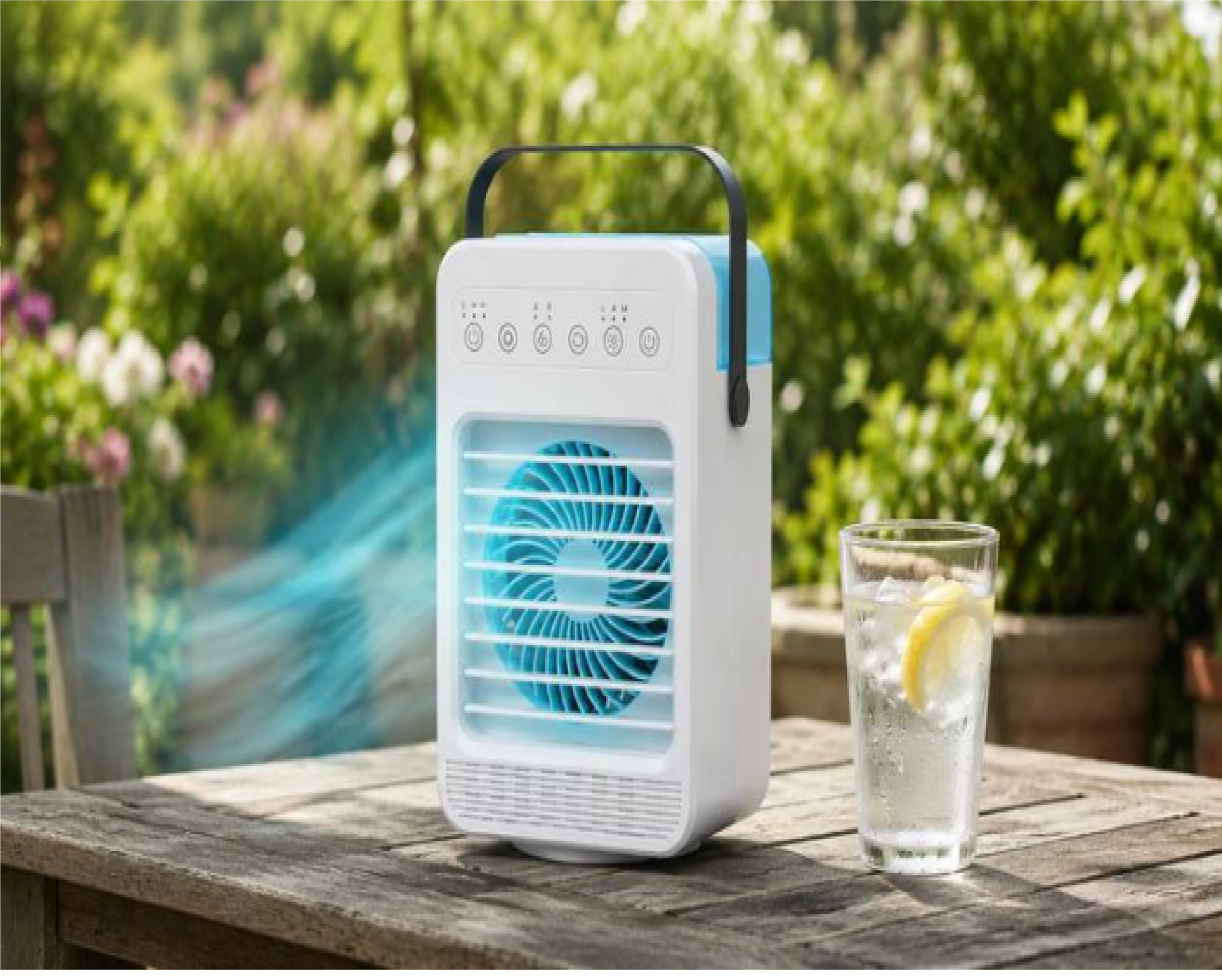
CoolJet Portable AC
The Evolution of Indoor Comfort: From Fixed Systems to CoolJet
CLICK HERE OFFICIAL WEBSITE
For over a century, indoor climate control has been defined by one assumption: that cooling requires permanent infrastructure. From the earliest industrial refrigeration systems to the window units and split-system air conditioners of the modern era, comfort has been tethered to architecture. Buildings were designed around cooling ducts, tenants signed leases contingent on existing HVAC systems, and entire industries grew up around the installation, maintenance, and repair of fixed cooling infrastructure. The result was a world in which thermal comfort became a privilege of property ownership — or at least, of landlord benevolence.
That world is changing. The rise of portable, personal cooling technology represents not merely a product innovation but a fundamental shift in how we think about thermal comfort. CoolJet and its category of personal climate devices challenge the assumption that cooling must be whole-room, whole-building, or whole-infrastructure. Instead, they propose a simpler, more elegant proposition: that the most effective cooling is the cooling that reaches you directly, wherever you are, without asking permission from your landlord, your architect, or your electricity bill.
This document traces that evolution — from the era of fixed systems and their many limitations, through the search for more agile solutions, to the emergence of CoolJet as a defining product in the personal cooling category. We examine the technology inside these devices, the design philosophy that drives them, the practical realities of their performance, and the direct-to-consumer market dynamics that define how they reach users. Whether you are a renter frustrated by summer heat, a student in a poorly ventilated dormitory, or a professional seeking focused comfort at your desk, this is the story of how personal climate control became not just possible, but accessible.
The Era of Fixed Infrastructure
Traditional air conditioning systems have dominated the cooling market for decades, and for good reason: when they work, they work comprehensively. A well-installed central air system or a properly sized split-unit can transform an entire room, an entire floor, or an entire building into a climate-controlled environment. The technology is mature, the engineering is proven, and the results — in ideal circumstances — are impressive. However, the circumstances are rarely ideal for the average person seeking relief from summer heat.
The first and most significant barrier is cost. A professional installation of a traditional air conditioning system routinely runs into the thousands of pounds, encompassing not only the unit itself but the labour, the ducting or pipework, the electrical modifications, and the ongoing maintenance contracts that keep the system operational. For homeowners with long-term plans, this investment can make sense. For renters, students, or anyone in temporary accommodation, it is simply not an option — and in many rental agreements, it is explicitly prohibited. Landlords retain control over structural modifications, and drilling through walls or installing external condenser units is almost universally off-limits.
Beyond the financial and contractual barriers lies the environmental cost. Traditional compressor-based air conditioning systems are among the most energy-intensive appliances in the modern home. A single unit running through a hot summer can add hundreds of pounds to an electricity bill, creating the phenomenon known as “summer bill shock” — the unpleasant surprise of an energy invoice that dwarfs every previous month. For households already stretching their budgets, this creates a cruel paradox: the hotter it gets, the more expensive it becomes to seek relief.
High Installation Costs
Professional fitting, ducting, and electrical work routinely exceed £2,000 for a basic split-system installation.
Renter Restrictions
Landlord policies and tenancy agreements prohibit structural modifications in the majority of UK rental properties.
Energy Footprint
Traditional compressor units draw significant power, with summer running costs adding hundreds of pounds to household bills.
The Search for Agility
As urban living patterns shifted and the modern workforce became increasingly mobile, the limitations of fixed cooling infrastructure became impossible to ignore. The rise of co-working spaces, short-term rentals, student accommodation, and remote work created a generation of users whose living and working environments changed frequently — sometimes multiple times per year. A cooling solution that required professional installation and permanent fixtures was fundamentally misaligned with this lifestyle. People needed cooling that moved with them, not cooling that anchored them to a single location.
The first wave of portable air conditioners attempted to address this need, but with mixed results. Early portable units were heavy, loud, and required cumbersome exhaust hoses to be routed through windows — often defeating the purpose of portability entirely. The tubes were awkward, the seals were imperfect, and the noise levels made them unsuitable for bedrooms or quiet work environments. Many users found that the inconvenience of setting up and operating these units outweighed the cooling benefit they provided. The promise of agility remained unfulfilled.
Simultaneously, the broader consumer electronics market was moving towards miniaturisation, USB-powered operation, and aesthetic design. Smartphones, laptops, and wearable technology had conditioned users to expect powerful functionality in compact, well-designed packages. The contrast between the sleek devices on their desks and the clunky, industrial-looking portable AC units in the corner became increasingly stark. The market was ready for a new approach — one that combined genuine cooling capability with the portability, quietness, and design sensibility that modern consumers had come to expect.
The Mobile Lifestyle Demand
Modern users expect technology that adapts to their environment, not the other way around. Cooling is no exception.
- Co-working and remote work flexibility
- Short-term rental and student accommodation
- Outdoor and semi-outdoor usage scenarios
- Multi-room households without central AC
- Travel and temporary workspace cooling
CoolJet: A Shift in Approach
CoolJet represents a fundamental repositioning of what personal cooling can be. Rather than attempting to compete with traditional air conditioning on its own terms — cooling entire rooms through powerful compressor systems — CoolJet asks a different question: what if cooling didn’t need to be whole-room? What if the most effective approach was to create a personal chill zone, a micro-climate of comfort that surrounds the individual rather than the architecture?
This shift in thinking has profound practical implications. A traditional air conditioner must work hard to cool every cubic metre of a room, regardless of whether anyone is occupying all of that space. CoolJet focuses its cooling output on the immediate personal environment — the roughly 150 square feet that constitutes a bedroom sleeping area, a desk workspace, or a home office corner. By narrowing the target, it can deliver meaningful thermal relief using a fraction of the energy, at a fraction of the cost, and without any of the installation complexity.
The plug-and-play philosophy is central to CoolJet’s appeal. There is no drilling, no tools, no technicians, and no landlord permissions required. The unit arrives in a box, is plugged into a standard USB port or USB-C power source, and begins providing cooling within seconds. This democratization of cooling technology is significant: it means that thermal comfort is no longer the exclusive domain of property owners or those with substantial disposable income. Students, renters, office workers, and anyone in temporary or shared accommodation can access meaningful cooling on their own terms.
Plug-and-Play Setup
No drilling, no tools, no technicians. CoolJet is operational within seconds of unboxing — simply connect to any USB power source and begin cooling immediately.
150 sq ft Personal Zone
Engineered for the spaces that matter most: your bedside, your desk, your home office. Focused cooling where you actually are, not where the thermostat is.
Renter-Friendly Design
Completely non-invasive. No structural modifications, no permanent fixtures, no landlord approvals. Take it with you when you move — it travels as easily as a laptop.
Inside the Technology: Peltier vs. Evaporative Models
One of the most important — and most confusing — aspects of the personal cooling market is the diversity of underlying technologies. CoolJet and similar products do not all operate on the same principle, and understanding the distinction is critical for setting realistic expectations. The two dominant approaches are Peltier thermoelectric cooling and evaporative misting technology, each with distinct physics, performance characteristics, and optimal use cases.
Peltier thermoelectric systems work by passing an electrical current through a junction of two different materials, creating a temperature differential — one side becomes cold, the other hot. A fan then blows air across the cold side, delivering cooled airflow to the user. This is genuine refrigeration at a miniature scale, and it does not depend on ambient humidity to function. Peltier-based units tend to be more consistent in their cooling output across different environmental conditions, though they draw slightly more power than evaporative alternatives.
Evaporative cooling, by contrast, relies on the principle that water evaporation absorbs heat. These units draw air through a water-saturated filter or misting chamber, and the evaporation process lowers the air temperature before it is blown toward the user. This approach is highly energy-efficient — often running on minimal USB power — but its effectiveness is directly tied to ambient humidity. In dry conditions, evaporative cooling can be remarkably effective. In humid conditions, the evaporation rate slows and cooling performance diminishes accordingly.
Peltier Thermoelectric
- Genuine refrigeration via electrical current
- Consistent performance regardless of humidity
- Slightly higher power draw
- Suitable for all climate conditions
- Cooling differential of 5–10°C achievable
Evaporative Misting
- Cooling via water evaporation physics
- Highly energy-efficient USB operation
- Performance tied to ambient humidity levels
- Best suited to dry climate conditions
- Additional humidification benefit in dry air
Both technologies represent a dramatic reduction in energy consumption compared to traditional compressor-based air conditioning. USB-powered operation typically draws between 5 and 15 watts, versus 1,000 to 3,000 watts for a conventional AC unit — a difference of two orders of magnitude.
Design Philosophy: User-Centric Mobility
The physical design of CoolJet reflects a clear set of priorities: it must be light enough to carry effortlessly, compact enough to fit on a desk or bedside table without dominating the space, and aesthetically pleasing enough that users are happy to have it visible in their personal environment. These are not trivial design challenges. Achieving genuine cooling capability within a sub-1.2 kg form factor requires careful engineering trade-offs, and the result is a product that feels more like a premium consumer electronic than an appliance.
Portability extends beyond weight. CoolJet’s USB-C power compatibility means it can run from a laptop, a power bank, a car charger, or a portable battery — making it genuinely usable both indoors and outdoors. This versatility opens up usage scenarios that traditional cooling simply cannot address: cooling at an outdoor event, relief during a power cut (provided a charged power bank is available), or use in a garden workspace where no mains power is accessible. The ability to decouple cooling from fixed electrical infrastructure is a meaningful liberation for users in a wide range of living situations.
The balance of aesthetics and function is another area where CoolJet distinguishes itself from earlier generations of portable cooling. Whisper-quiet motors ensure that the unit does not create the noise pollution that made previous portable ACs unsuitable for bedrooms or focused work environments. Ambient lighting options — typically soft, adjustable LEDs — add a layer of visual calm that complements the thermal comfort the device provides. The result is a product that users integrate into their personal spaces not as a necessary evil, but as a genuinely welcome addition.
Maximum Weight
Designed for single-hand transport between rooms, offices, or outdoor locations without fatigue.
Typical Power Draw
USB-powered operation at a fraction of the energy cost of traditional compressor air conditioning.
Quiet Operation
Whisper-quiet motor technology suitable for bedrooms, libraries, and focused work environments.
Power Bank Runtime
Typical battery life when running from a standard 10,000 mAh USB-C power bank on medium setting.
The Practical Performance Reality
Honest communication about performance is one of the most important services a product guide can provide. CoolJet and similar personal cooling devices are genuinely effective within their designed parameters — but those parameters matter. Understanding them is the difference between a satisfied customer and a disappointed one. The single most important factor in cooling effectiveness is environmental humidity. Evaporative models, in particular, see their performance degrade as ambient humidity rises, because the rate of evaporation — and therefore the cooling effect — slows in moist air. In arid summer conditions, these units can feel remarkably effective. In a humid British summer, the effect will be more subtle, though still perceptible.
Room insulation and air flow also play significant roles. A personal cooling device works best in a relatively enclosed space where the cooled air can accumulate around the user rather than dissipating immediately into a large, open, or poorly insulated area. This is precisely why CoolJet succeeds at desks and bedsides — these are naturally semi-enclosed personal zones where directed airflow creates a noticeable micro-climate. Attempting to use a personal cooler to cool an entire living room would be like using a desk lamp to illuminate a football pitch: the technology is capable, but the scale is mismatched.
The precision control features available on CoolJet — multi-speed fan settings, adjustable airflow direction, and programmable timers — are not merely convenience features. They are essential tools for managing the personal cooling experience. A user can set a lower fan speed for overnight use, program a timer to switch off after falling asleep, or increase airflow during the hottest part of the day. This level of customization allows users to create their own micro-climate protocols, adapting the device to their specific comfort preferences and usage patterns.
Understanding these performance boundaries is not a limitation — it is an empowerment. When users know what CoolJet is designed to do, they can deploy it strategically and achieve the best possible results. The device excels at its intended purpose: delivering targeted, personal thermal relief in the spaces where individuals actually spend their time.
The Direct-to-Consumer Phenomenon
CoolJet’s distribution model reflects a broader trend in consumer technology: the shift away from traditional retail towards direct-to-consumer (DTC) sales channels. By selling exclusively through official websites and controlled online platforms, CoolJet bypasses the traditional retail markup chain, maintaining tighter control over pricing, warranty fulfillment, and customer support. For the consumer, this typically means more competitive pricing than would be available through a physical retailer, along with a more direct line of communication with the manufacturer.
The bundle economy is a distinctive feature of the CoolJet purchasing model. Rather than selling single units at a fixed price, the official channels typically offer sliding scale discounts for multi-unit purchases — buy two and save a percentage, buy three and save more. This incentivizes users to create a network of personal cooling zones throughout their home or workspace, rather than relying on a single unit. For households with multiple occupants or individuals who work across several locations during the day, this bundle approach can represent significant value.
What to Watch When Buying Direct
- Verify the official website URL before purchasing
- Read the full returns and warranty policy before checkout
- Check shipping timelines and tracking provisions
- Understand the satisfaction guarantee terms
- Keep order confirmation and transaction records
- Be wary of third-party sellers offering “deals”
Managing expectations is a critical component of the DTC experience. Without a physical showroom to examine the product, touch the materials, or hear the noise level, consumers must rely on product descriptions, reviews, and policy documents to make informed decisions. This makes it essential to read the terms and conditions — particularly the returns policy, the warranty scope, and the satisfaction guarantee — before completing a purchase. The 30-day trial period that has become industry-standard in this category is a genuine consumer protection, but only if the buyer understands the conditions under which it applies. Returns may require the product to be in original packaging, and shipping costs may or may not be covered depending on the reason for return.
Official Channel Verification
Always purchase through the verified official CoolJet website. Third-party marketplaces may carry counterfeit or outdated models without proper warranty support.
Bundle Discount Structure
Multi-unit purchases unlock progressive discounts, making it cost-effective to establish cooling zones in multiple rooms or workspaces simultaneously.
Policy Literacy
Understanding the returns policy, warranty scope, and satisfaction guarantee terms before purchasing protects the consumer and ensures a smooth experience if issues arise.
Navigating the Market Today
The personal cooling market has grown rapidly, and with that growth has come a proliferation of products, brands, and claims. Not all personal cooling devices are created equal, and not all sellers are trustworthy. Navigating this market successfully requires a combination of self-awareness — understanding your own climate conditions and usage needs — and market awareness — knowing how to identify genuine products from reputable sources.
The first step is an honest assessment of local climate conditions. If you live in an area with consistently high humidity — coastal regions, certain urban areas, or locations prone to muggy summer weather — an evaporative cooling model may not deliver the performance you expect. In these conditions, a Peltier-based unit will provide more consistent results. Conversely, if your summers are hot and dry, an evaporative model may offer excellent cooling at minimal energy cost. Understanding your environment before purchasing is the single most effective way to ensure satisfaction.
The second step is channel discipline. The popularity of products like CoolJet has attracted imitators — companies producing visually similar devices with inferior components, misleading specifications, and no genuine after-sales support. These imitators often appear on third-party marketplaces at prices that seem too good to be true, because they are. The official CoolJet direct channel exists not only to control pricing but to ensure that every customer receives a genuine product backed by proper warranty and support infrastructure. The modest premium paid through official channels is, in effect, an insurance policy against counterfeit hardware and abandoned warranties.
Assess Your Climate
Evaluate local humidity levels and room conditions to determine whether Peltier or evaporative technology suits your environment.
Verify the Channel
Purchase only through the official CoolJet website to guarantee genuine hardware, valid warranty, and proper customer support.
Review the Policy
Read the returns policy, satisfaction guarantee, and warranty terms before completing your purchase to understand your rights.
Begin Your Trial
Take full advantage of the 30-day satisfaction period to test the device in your actual environment under real-world conditions.
Conclusion: The Future of Personal Climate Control
The story of CoolJet is, at its heart, a story about empowerment. For generations, thermal comfort has been mediated by infrastructure — by the buildings we live in, the systems installed within them, and the permissions required to modify them. CoolJet and the category of personal cooling devices it represents breaks that mediation. It places the power to achieve comfort directly in the hands of the individual, without requiring ownership, installation, or institutional approval.
This is not to suggest that personal cooling devices will replace traditional air conditioning. They serve different purposes, operate at different scales, and address different needs. What CoolJet represents is an expansion of the cooling toolkit — a low-barrier, high-impact option for situations where traditional systems are impractical, unavailable, or simply unnecessary. For the renter in a top-floor flat, the student in a poorly ventilated dormitory, the remote worker at a sun-drenched desk, or the outdoor enthusiast seeking relief at a summer event, personal cooling is not a compromise. It is the most appropriate solution available.
The broader implications extend beyond individual comfort. As energy costs rise and environmental awareness grows, the appeal of targeted, low-power cooling solutions will only increase. The idea that we should cool entire buildings when we only occupy a fraction of the space is increasingly difficult to justify — economically or environmentally. Personal climate control represents a more efficient, more sustainable approach to thermal comfort, one that aligns individual needs with broader resource considerations.
When the room is too big to cool, personal cooling becomes the most effective solution. CoolJet does not fight the architecture — it transcends it.
Targeted
Cooling delivered precisely where it is needed, without waste.
Efficient
USB-powered operation at a fraction of traditional energy costs.
Accessible
No installation, no permissions, no barriers to personal comfort.
Sustainable
Lower energy footprint aligned with responsible consumption.