Melara Air Pillow
The Melara Air Pillow: A New Era of Personalised Sleep
VISIT OFFICIAL WEBSITE
Sleep is the foundation of human health — yet for millions, it remains a nightly struggle. The humble pillow, a constant companion through every night, has barely evolved in decades. The Melara Air Pillow challenges that stagnation, introducing a scientifically engineered sleep surface that adapts to your body, your posture, and your environment. This document explores the design philosophy, technological innovations, and real-world impact of a product built to redefine what restorative sleep truly means.
The Hidden Cost of the Flat Rectangle
For most of modern history, the pillow has been little more than a stuffed rectangle — a passive object placed beneath the head with no regard for anatomy, posture, or individual physiology. This design flaw carries an enormous hidden cost. When a flat pillow fails to fill the natural gap between the neck and mattress, the cervical spine is forced into an unnatural angle. Over hours of sleep, this misalignment compounds, placing chronic stress on muscles, ligaments, and vertebrae that were never designed to sustain such positions.
The consequences extend far beyond a stiff neck upon waking. Research into sleep ergonomics has consistently demonstrated that poor pillow support disrupts the architecture of sleep itself. When the spine is misaligned, the body remains in a state of low-grade physical stress throughout the night — micro-adjustments and tension prevent the nervous system from fully entering the deep, restorative phases of sleep. REM cycles are fragmented, slow-wave sleep is reduced, and the body’s natural repair processes are interrupted.
Heat retention represents a second, often overlooked failure of traditional pillow design. Conventional memory foam and polyester-fill materials trap body heat close to the head and neck, creating a warm microclimate that actively works against the body’s natural temperature drop during sleep onset. The human body must lower its core temperature by approximately one degree to initiate and maintain sleep — a process that heat-trapping materials directly impede. The result is restless tossing, delayed sleep onset, and premature waking.
Consider the cumulative effect: millions of people wake each morning carrying the physical burden of a poorly designed sleep surface. Chronic neck pain, shoulder tension, tension headaches, and persistent fatigue are not inevitable facts of adult life — they are, in many cases, the direct consequence of sleeping on a product that was never designed to support the human body properly. The flat rectangle has persisted not because it works, but because the sleep industry has been slow to innovate beyond it.
The Core Problems
- Forced unnatural cervical angles causing chronic pain
- Traditional materials failing to adapt to posture shifts
- Heat retention disrupting REM sleep cycles
- Poor spinal alignment affecting breathing and circulation
The Human Cost
Millions of adults report waking with neck stiffness, shoulder tension, or tension headaches — symptoms directly attributable to inadequate pillow support. Sleep studies have linked poor cervical alignment to fragmented REM cycles, reduced slow-wave sleep, and elevated cortisol levels upon waking. The flat rectangle is not a neutral object; it is an active source of physical stress that compounds night after night, year after year.
The Engineering Breakthrough
The Melara Air Pillow represents a fundamental departure from conventional pillow design philosophy. Where traditional manufacturers focused on material softness or loft height as the primary variables, Melara’s engineering team identified the true problem: the absence of zoned, anatomically responsive support. The breakthrough was not incremental — it was a complete reimagining of what a sleep surface should accomplish. Rather than treating the pillow as a passive cushion, the design team approached it as an active structural interface between the sleeper and the mattress.
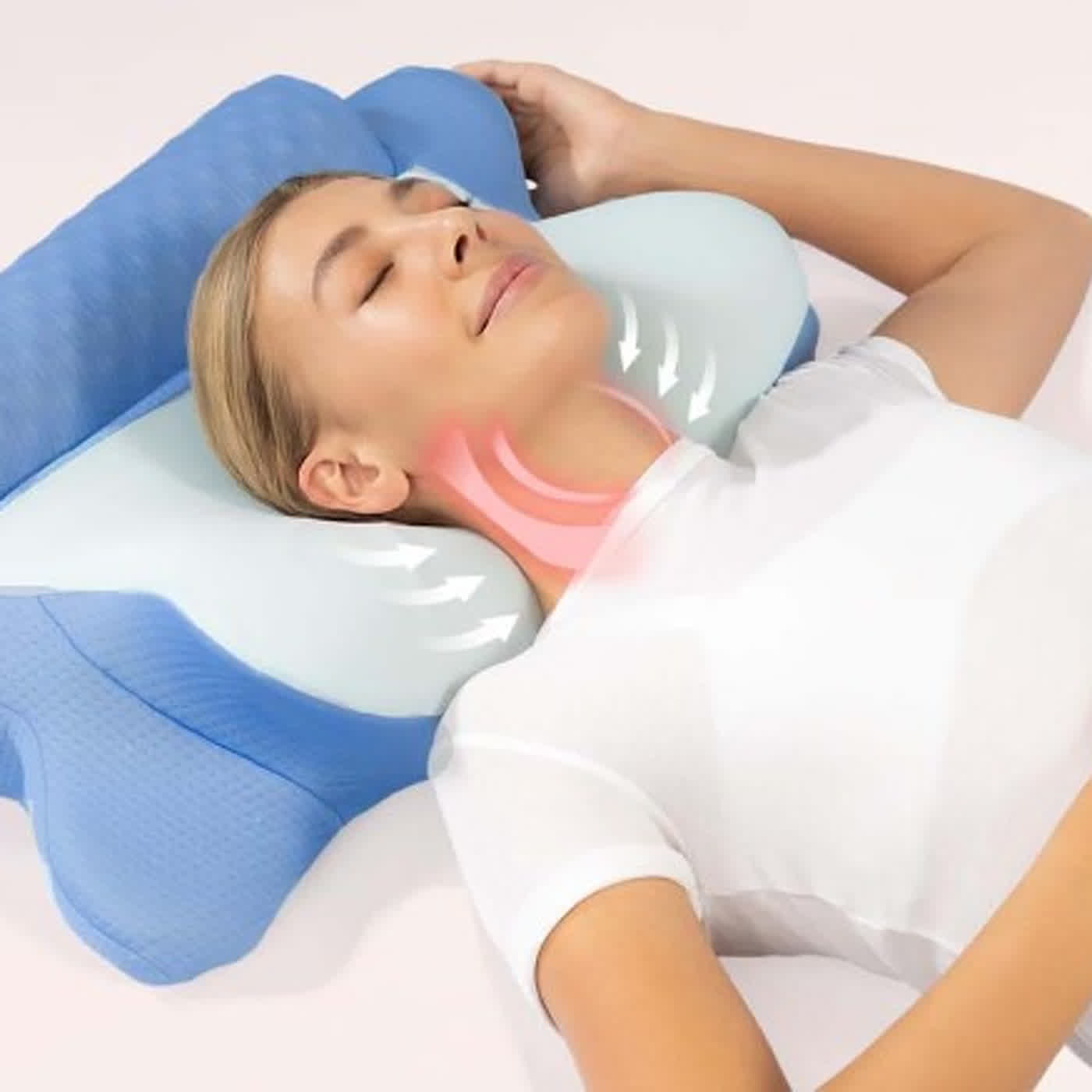
The cornerstone of this breakthrough is the butterfly contour architecture — a three-dimensional form engineered to mirror the natural geometry of the human head, neck, and shoulders. This contour is not decorative; it is the product of extensive biomechanical research into cervical spine alignment across different sleep positions. Every curve, elevation, and recess serves a specific physiological purpose, working in concert to maintain the head and neck in a neutral, stress-free position regardless of how the sleeper moves through the night.
The shift in design thinking was significant. Previous ergonomic pillows had attempted to address alignment through simple height adjustment or firmer foam — approaches that treated symptoms rather than causes. Melara’s team recognised that the cervical spine requires different support at different points: the occipital region at the base of the skull needs gentle cradling, the cervical curve needs active support to prevent collapse, and the shoulders need clearance to prevent lateral tilting. A single uniform material cannot address all three simultaneously. The solution was multi-zone construction, with each region of the pillow engineered to a different density and profile.
The result is a product built to maintain neutral alignment through the entire sleep cycle. Unlike static foam pillows that hold a single shape regardless of movement, the Melara Air Pillow’s architecture works dynamically — the butterfly wings respond to lateral movement, the central cradle adapts to supine positioning, and the shoulder cutouts accommodate natural arm placement. This is sleep engineering at a level of sophistication previously reserved for medical orthopaedic devices, now made accessible as a consumer sleep product.
This three-phase approach — from identifying the fundamental flaw in traditional pillow design, through the development of the butterfly contour architecture, to achieving consistent neutral alignment — represents the engineering philosophy that sets the Melara Air Pillow apart from every conventional sleep surface on the market.
Anatomy of the Butterfly Design
The butterfly contour is not a single feature — it is an integrated system of three interdependent design elements, each addressing a specific anatomical requirement. Understanding how these elements work together reveals the sophistication of the engineering and explains why the Melara Air Pillow delivers results that conventional pillows simply cannot match. Each zone of the butterfly design has been precisely shaped and density-graded to serve a distinct physiological function.
Elevated Side Wings
The raised lateral wings are engineered to fill the gap between the neck and mattress during side sleeping — the most common sleep position among adults. By cradling the head at the correct height, the wings prevent the cervical spine from collapsing sideways, maintaining a straight, neutral alignment from the base of the skull through to the upper thoracic vertebrae. This is particularly important for side sleepers with broader shoulders, who experience the greatest lateral displacement without proper support.
Recessed Central Cradle
The gently depressed centre zone serves back sleepers, providing a shallow cradle that supports the natural lordotic curve of the cervical spine without forcing the head forward or allowing it to tilt back. This recessed area minimises neck strain by distributing the weight of the head across a broader surface, reducing pressure on any single vertebra. The result is a supported, comfortable position that allows the neck muscles to fully relax — a prerequisite for deep, restorative sleep.
Targeted Shoulder Cutouts
One of the most innovative features of the butterfly design is the pair of shoulder cutouts positioned at the base of each side wing. These recesses allow the shoulder to nestle naturally into the pillow’s profile, eliminating the lateral pressure that causes arm numbness and shoulder pain in conventional designs. By removing this pressure point, the cutouts also prevent the compensatory postural adjustments that lead to tossing and turning throughout the night.
Together, these three elements create a sleep surface that is simultaneously supportive and accommodating — firm where structure is needed, yielding where comfort is required. The butterfly design does not force the sleeper into a single position; rather, it provides appropriate support for whichever position the sleeper naturally adopts, and transitions smoothly as movement occurs. This is the difference between a pillow that works with the body and one that works against it.
Innovation in Temperature Control
Thermal regulation during sleep is one of the most underappreciated factors in sleep quality — and one of the areas where traditional pillow design has failed most dramatically. The human body follows a circadian temperature rhythm, with core temperature dropping in the evening to facilitate sleep onset and reaching its lowest point in the early morning hours. Any disruption to this thermal process — including heat trapped by bedding materials — can delay sleep, fragment sleep stages, and cause premature waking.
Traditional memory foam, for all its comfort benefits, is notoriously poor at managing heat. Its dense cellular structure acts as an insulator, trapping body heat in close proximity to the head and neck throughout the night. As the microclimate warms, the sleeper experiences discomfort that triggers micro-arousals — brief awakenings that fragment sleep without full conscious awareness. Over a full night, these micro-arousals can accumulate to significantly reduce sleep efficiency and the proportion of time spent in deep, restorative sleep stages.
The Melara Air Pillow addresses this challenge through a multi-layered approach to thermal management. At its core, the pillow uses an advanced cellular foam that has been engineered with an open-cell structure, allowing air to circulate freely through the material rather than being trapped within it. This is a fundamentally different approach from conventional foam, where closed cells create pockets of stagnant, warming air. The open-cell architecture ensures that heat generated by the head and neck is dissipated rather than accumulated.
Working in concert with the foam core, the pillow’s cover employs advanced moisture-wicking fabrics — materials originally developed for athletic performance wear, now adapted for sleep applications. These fabrics actively draw perspiration away from the skin surface, spreading it across a larger area where it can evaporate more efficiently. This process not only keeps the sleeper dry but also leverages evaporative cooling to further reduce the microclimate temperature. The combined effect of open-cell foam and moisture-wicking fabric creates a sleep surface that remains cool and comfortable throughout the night, regardless of ambient room temperature or individual thermal sensitivity.
Traditional Foam
- Dense, closed-cell structure traps heat
- No moisture management capability
- Microclimate warms progressively through the night
- Triggers micro-arousals and sleep fragmentation
Melara Air Technology
- Open-cell foam core enables continuous airflow
- Moisture-wicking fabric cover manages perspiration
- Active ventilation channels maintain cool microclimate
- Supports uninterrupted deep sleep stages
The Hybrid Approach: Air Meets Foam
The most sophisticated feature of the Melara Air Pillow is also its most user-empowering: the integration of adjustable internal air chambers within the foam structure. This hybrid approach represents the culmination of the pillow’s engineering philosophy — the recognition that no two sleepers are identical, and that even a single sleeper’s needs may vary from night to night depending on sleep position, physical condition, or personal preference. A pillow that offers only one level of firmness is, by definition, a compromise for most users.
The air chamber system is elegantly simple in concept but sophisticated in execution. Internal chambers run longitudinally through the pillow’s core, and can be inflated or deflated via a discreet valve system. Adding air increases the overall firmness and loft of the pillow, providing greater structural support for those who prefer a firmer sleep surface or who require additional elevation for medical or postural reasons. Releasing air creates a softer, more yielding surface that conforms more closely to the contours of the head and neck — preferred by those who find firm pillows uncomfortable or who sleep in multiple positions throughout the night.
What makes this system remarkable is its speed and precision. Users can adjust their support level in seconds, without removing the pillow from the bed or disrupting their sleep routine. The transition from a soft cushion to a firm, supportive structure requires only a few breaths into the valve or a brief release of air. This immediacy means that the pillow can be fine-tuned in real time — if a sleeper changes position during the night and finds the current firmness unsuitable, a quick adjustment restores optimal support without requiring a full awakening.
The hybrid approach also addresses a limitation inherent in pure foam or pure air pillow designs. Pure foam pillows offer excellent contouring but lack adjustability; once manufactured, their firmness is fixed. Pure air pillows offer adjustability but often lack the conforming comfort and structural stability that foam provides. By combining both technologies, the Melara Air Pillow delivers the best properties of each: the adaptive comfort of foam and the customisable support of air. This is the transition from static bedding to responsive, personalised sleep technology — a category shift that positions the Melara Air Pillow at the forefront of the sleep innovation landscape.
Soft Setting
Maximum conformity for side and combination sleepers who prefer a plush, enveloping feel
Medium Setting
Balanced support suitable for most sleepers, offering both comfort and structural alignment
Firm Setting
Maximum elevation and support for back sleepers, those with neck pain, or medical requirements
The Traveller’s Transformation
For frequent travellers, sleep disruption is an occupational hazard. Hotel pillows are notoriously inconsistent — too soft, too firm, too high, or too flat — and the unfamiliar sleep environment compounds the problem. The result is a pattern of poor sleep that accumulates across trips, contributing to jet lag, reduced cognitive performance, and physical fatigue. The Melara Air Pillow was designed with this challenge in mind, offering a solution that brings the consistency of home sleep to any environment on earth.
Portability has been redefined through the use of advanced compressible materials that allow the pillow to be reduced to a fraction of its expanded volume for transport. Unlike bulky traditional travel pillows that offer minimal support and are quickly discarded in favour of inadequate hotel alternatives, the Melara Air Pillow maintains its full ergonomic architecture whether expanded on a hotel bed, compressed in a carry-on bag, or partially inflated for use in a vehicle or office chair. The compressibility does not compromise the structural integrity of the butterfly contour — upon decompression, the pillow returns to its designed shape with full support properties intact.
The psychological benefit of this consistency should not be underestimated. Sleep researchers have identified environmental familiarity as a significant factor in sleep quality — the brain associates specific sensory inputs with the safety and comfort required for deep sleep. By providing a consistent sleep surface regardless of location, the Melara Air Pillow creates a portable sleep anchor that signals to the brain that it is time to rest, even in unfamiliar surroundings. This is particularly valuable for business travellers who must maintain peak cognitive performance across time zones and changing environments.
The pillow’s versatility extends beyond travel. For those who work from home, nap during the day, or spend extended periods in reclining positions, the Melara Air Pillow provides consistent neck support that conventional pillows cannot match. The adjustable air chambers allow the pillow to be configured for seated or reclined use, making it a genuinely multi-environment sleep tool rather than a product limited to the bedroom. A single, familiar sleep foundation that adapts to any environment — this is the promise that the Melara Air Pillow delivers for travellers and home users alike.
Long-Haul Travel
Compresses to carry-on size, expands to full ergonomic support in any hotel room worldwide
Office & Commute
Adjustable firmness provides neck support during desk work, video calls, or car journeys
Home Sleep
Full butterfly contour architecture delivers premium ergonomic support every night
Lightweight Design
Advanced materials reduce weight without compromising structural integrity or comfort
Real-World Impact: The Morning After
The true measure of any sleep product is not its technical specifications but its effect on how people feel when they wake. The Melara Air Pillow has been evaluated not only in laboratory settings but across thousands of real-world users, and the results are consistent: people who switch to the Melara Air Pillow report measurable improvements in their morning experience — physically, mentally, and emotionally. These are not marginal changes; for many users, they represent a transformation in their relationship with sleep itself.
The most commonly reported improvement is a significant reduction in daily stiffness and tension. Users who previously woke with neck pain, shoulder tension, or tension headaches describe these symptoms diminishing or disappearing entirely within the first week of use. This is a direct consequence of proper cervical alignment: when the spine is supported in its natural position throughout the night, the muscles and ligaments are able to relax fully rather than remaining in a state of protective tension. The cumulative effect of nights without this tension is a body that feels looser, more mobile, and less burdened by the residual stiffness that many adults have come to accept as normal.
Improved circulation through proper neck positioning produces a secondary benefit that users consistently note: higher morning energy levels. When the cervical spine is aligned, blood flow to the brain is unobstructed, and the lymphatic drainage that occurs during sleep proceeds efficiently. The result is a waking experience that feels qualitatively different — users describe feeling more alert, more refreshed, and more ready to engage with the day. This is not simply the absence of pain; it is the presence of genuine restorative benefit that extends well beyond the bedroom.
Better breathing paths and improved pressure distribution also contribute to reduced snoring and less tossing and turning. When the airway is not compressed by poor neck positioning, breathing becomes easier and more consistent — a benefit not only for the sleeper but for their partner as well. Reduced tossing means fewer micro-arousals and a higher proportion of time spent in deep, restorative sleep stages. The morning after a night on the Melara Air Pillow is, for many users, a fundamentally different experience from the morning after a night on a conventional pillow.
Average Rating
Consistently rated 4.9 out of 5 across verified user reviews in 2026
Days to Relief
Most users report noticeable reduction in neck pain within one week of use
Would Recommend
Of users surveyed said they would recommend the pillow to a friend or family member
Beyond the Cushion: A Wellness Investment
The Melara Air Pillow occupies a category that did not previously exist: the sleep wellness device. Where traditional pillows are classified as bedding accessories — commodities purchased on price and replaced without thought — the Melara Air Pillow functions as a tool for spinal health, thermal regulation, and sleep quality optimisation. This distinction is not merely semantic; it reflects a fundamental shift in how consumers understand the relationship between their sleep environment and their overall health.
The data from 2026 supports this reclassification. User satisfaction scores consistently place the Melara Air Pillow at 4.9 out of 5 — a rating that reflects not just comfort but perceived health benefit. Users do not describe the pillow as comfortable; they describe it as transformative. They report changes in their daily energy, their pain levels, their mood, and their cognitive performance — outcomes that extend far beyond the bedroom and into every aspect of waking life. This breadth of impact is what distinguishes a wellness investment from a bedding purchase.
This shift in consumer priorities reflects a broader cultural movement toward sleep as a cornerstone of health. For decades, sleep was treated as a passive state — something that happened to us rather than something we actively optimised. The growth of sleep science, wearable sleep trackers, and evidence-based sleep hygiene practices has changed this relationship fundamentally. Consumers now understand that sleep quality is not a luxury but a biological necessity, and that the tools they use during sleep have a direct impact on their health outcomes. The Melara Air Pillow sits at the intersection of this cultural shift and genuine engineering innovation.
The economic argument for this investment is compelling when viewed through a wellness lens. Chronic neck pain, tension headaches, and sleep disruption carry significant costs — in medical expenses, lost productivity, and reduced quality of life. A pillow that addresses these issues at their source represents not an expense but a prevention strategy. When the cost is measured against the value of pain-free mornings, sustained energy, and restorative sleep, the Melara Air Pillow emerges not as a premium purchase but as a rational investment in long-term health.
Wellness Benefits
- Cervical spine alignment and structural support
- Reduction in tension headaches and neck pain
- Improved sleep architecture and REM quality
- Enhanced morning energy and cognitive function
- Long-term prevention of postural deterioration
The Consumer Shift
The 2026 sleep wellness market reflects a fundamental change in consumer behaviour. Sleep is no longer a passive backdrop to life — it is recognised as an active pillar of health, alongside nutrition and exercise. Products that demonstrably improve sleep quality are commanding premium prices and generating exceptional loyalty. The Melara Air Pillow exemplifies this shift: a product that consumers do not simply use, but rely upon as part of their health regimen. High satisfaction scores and strong recommendation rates reflect not just product quality but genuine perceived value in users’ daily lives.
The Future of Restorative Sleep
The Melara Air Pillow is not the end point of sleep innovation — it is a milestone on a journey that has only just begun. What it demonstrates, with clarity and conviction, is that personalised ergonomics are not a niche concern but the new standard. The era of the one-size-fits-all flat rectangle is over, not because consumers demanded change, but because the science of sleep made change inevitable. When the evidence shows that proper spinal alignment, thermal regulation, and adaptive support produce measurably better sleep, the burden shifts to manufacturers to deliver those outcomes.
The progress from the failed flat rectangle to the customisable, smart-contour future represents more than a product evolution — it represents a paradigm shift in how we think about sleep. For most of history, sleep was treated as a uniform state that required uniform tools. The Melara Air Pillow proves that sleep is deeply individual, and that the tools we use during it should reflect that individuality. Adjustable firmness, zoned support, thermal management, and portability are not features added for marketing appeal; they are responses to the genuine, varied needs of real human bodies in real sleep environments.
The implications extend beyond the pillow itself. The success of the Melara Air Pillow signals to the broader sleep industry that consumers are ready — and willing to pay — for genuine innovation. It demonstrates that sleep products can be both scientifically rigorous and commercially successful, that ergonomics and aesthetics are not mutually exclusive, and that the bedroom is a legitimate frontier for technological advancement. As this paradigm takes hold, we can expect to see the principles embodied in the Melara Air Pillow — personalisation, adaptability, and evidence-based design — applied across the full spectrum of sleep products.
The call to action is straightforward: prioritise spinal alignment today to secure the deep, pain-free sleep of tomorrow. Sleep is not a passive state to be endured; it is an active process to be optimised. The tools exist. The science is clear. The Melara Air Pillow proves that a better night’s sleep is not a matter of luck or genetics — it is a matter of choosing the right support. Every night spent on an inadequate pillow is a night of missed restoration. The future of restorative sleep begins with a single decision: to treat sleep with the seriousness it deserves.
Personalised Ergonomics Are the Standard
The Melara Air Pillow proves that sleep surfaces must adapt to the individual — not the reverse. Customisable, zoned support is no longer optional; it is the baseline expectation for any serious sleep product.
From Static Bedding to Responsive Technology
The journey from the flat rectangle to the butterfly contour represents a fundamental category shift. Sleep products are now wellness devices, and the industry must rise to meet that standard.
Prioritise Alignment Today for Pain-Free Tomorrows
Every night of proper spinal alignment is an investment in long-term musculoskeletal health. The decision to upgrade your sleep surface is a decision to invest in your future self.
The Melara Air Pillow — engineered for alignment, designed for comfort, built for every night. Your best sleep starts here.